
What are never treated communities, and how does WHO’s new toolkit help NTD programs find them?

.png)
Neglected tropical disease (NTD) programs treat populations preventively, round after round, until the parasites lose enough hosts to sustain themselves and die out. Mass drug administration (MDA) campaigns deliver those treatments at scale, but the strategy can only work if enough people take the medicine consistently.
One bad campaign year where MDAs may miss a community or two is fairly normal. The problem is when the same communities get missed round after round, which can turn into an outbreak with transmission in the surrounding areas. WHO even has a name for communities that miss treatment from one MDA to the next: never treatment. While the phrase reads slightly awkwardly at first, it’s the term WHO and the programs working on finding these populations have settled on, so it’s the one we’ll use here.
In December, WHO and PAHO published Reaching never treated people to eliminate neglected tropical diseases, the first guidance dedicated to this specific problem. This article walks through what never treatment is, how programs find it, and how the Crosscut App can simplify the work.
What counts as never treatment
The toolkit defines never treatment as a self-reported state of never having ingested the indicated medicines during any round of MDA. Three parts of that definition shape how programs use it.
- Self-reported. The data comes from people's own survey answers, not from treatment registers.
- Never ingested. Accepting tablets and not swallowing them still counts as never treated.
- Any round. One missed campaign doesn't make someone never treated. The term describes people missed across every round.
WHO settled on the term over older labels like systematic non-compliance because those put the responsibility on the individual, while never treatment covers intentional reasons. Those reasons can be refusal or distrust, and unintentional ones, like a distributor who never came.
Why never treatment threatens elimination goals
WHO's 2021-2030 NTD road map sets elimination targets that depend on sustained high MDA coverage. When the same people go untreated across rounds, transmission can persist or return in the areas around them. Modeling in the new toolkit shows that higher levels of never treatment add years of additional MDA rounds before a program reaches its elimination threshold. The toolkit also calls never treatment an issue of equity, since the people being missed go without free medicines the program intended for them.
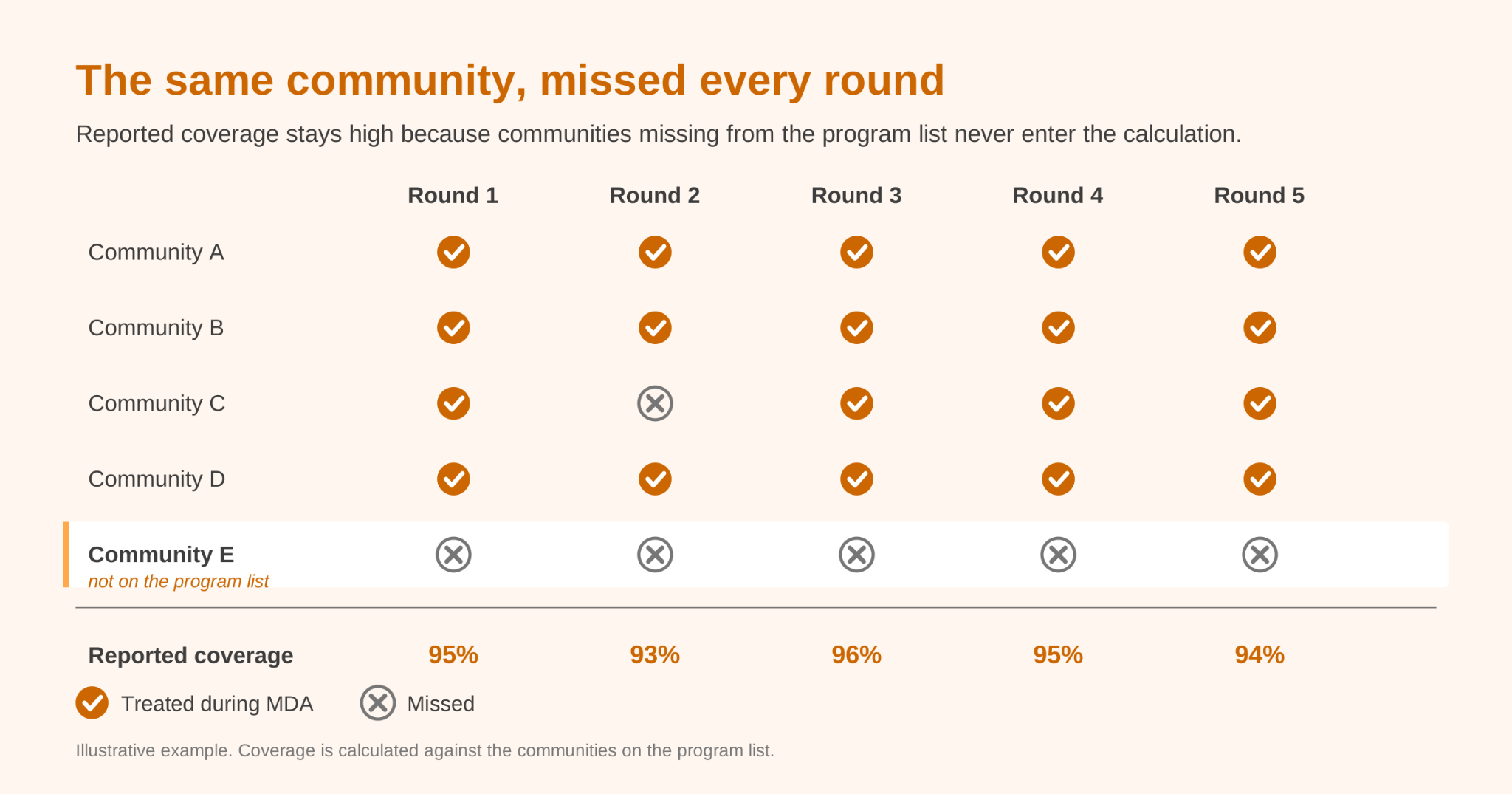
The challenge is that never treatment stays hidden due to the denominator problem. NTD programs calculate coverage against their population list, and communities that were never on the list aren’t in the denominator used to plan MDA. A campaign can report strong coverage every year while the same places go untreated, and transmission continues in those areas.
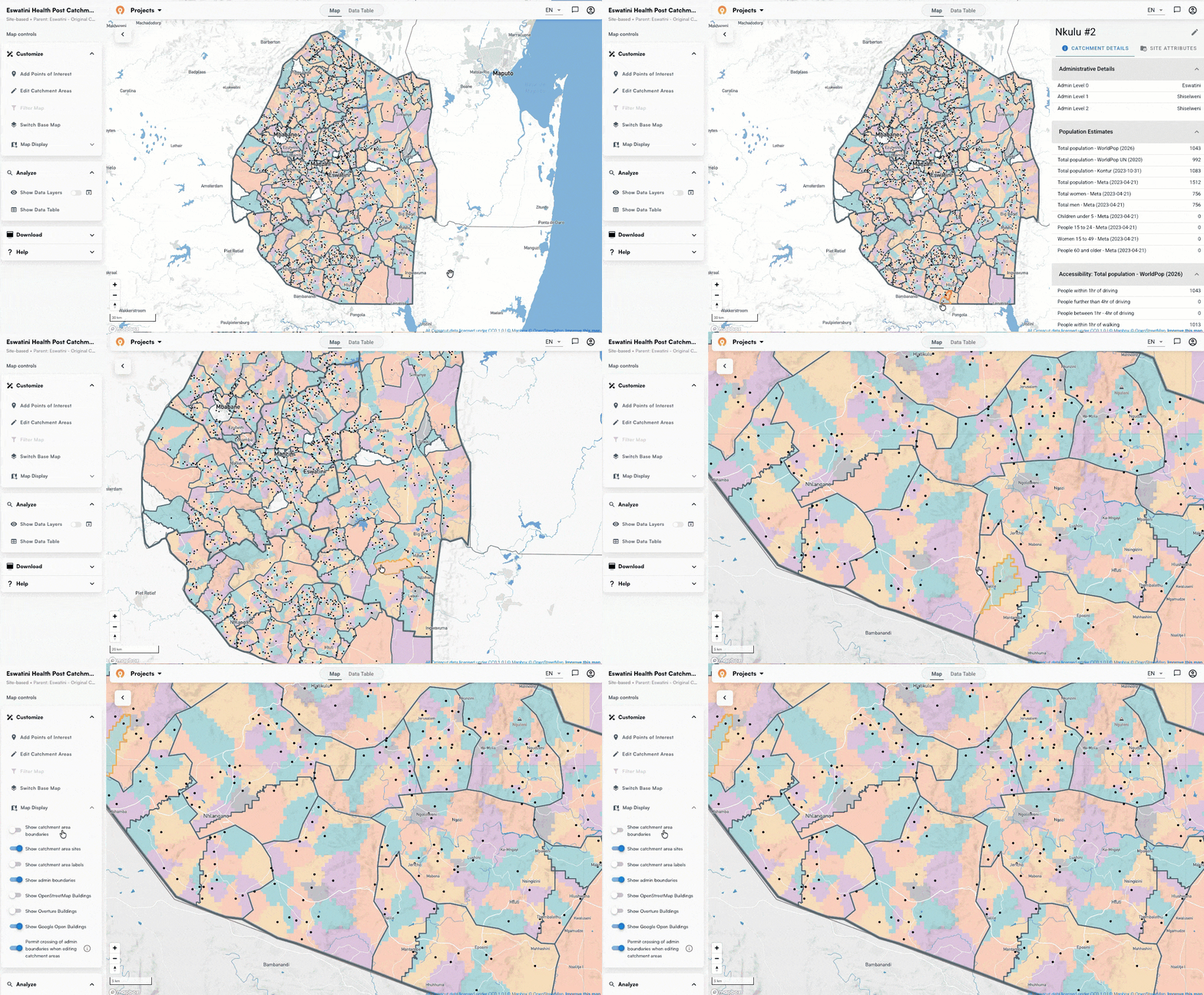
This gap is one of the first things we look for when a national health program brings its data into the Crosscut App. Generating catchment area maps from the program's own list can often reveal the communities the campaign is missing, because a populated settlement with no matching entry on the list stands out on a map in a way it doesn’t in a spreadsheet.
Why some people are never treated
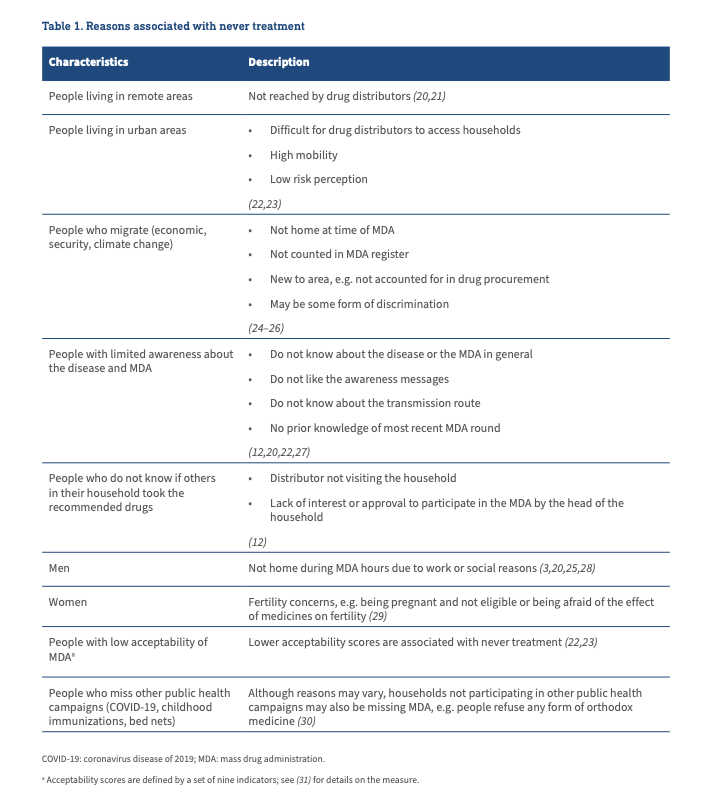
The toolkit sorts the reasons into two broad groups, and most programs will recognize both.
- Supply reasons. Communities too remote for drug distributors to reach, distributors who never come, or medicine that runs out before the far end of the route.
- Demand reasons. Distrust of government or health workers, migration, people away from home during distribution hours, or fertility concerns about the medicines themselves.
Remote means different things in different health programs. The standard hard-to-reach definition is a community several hours from a health facility. At the far end are places so isolated that survey teams camp overnight in the community because the round trip can't be done in a day. Those communities exist in every country we've worked in, and judging which ones qualify almost comes down to guesswork when all you have is a spreadsheet.
The Crosscut App models travel time from each health facility, so the settlements beyond a program's hard-to-reach threshold show up as a list instead of a judgment call. In Liberia, we built catchments from the Ministry's geocoded community data and used travel time analysis to divide supervisory areas before the MDA.
How national health programs find never treated communities
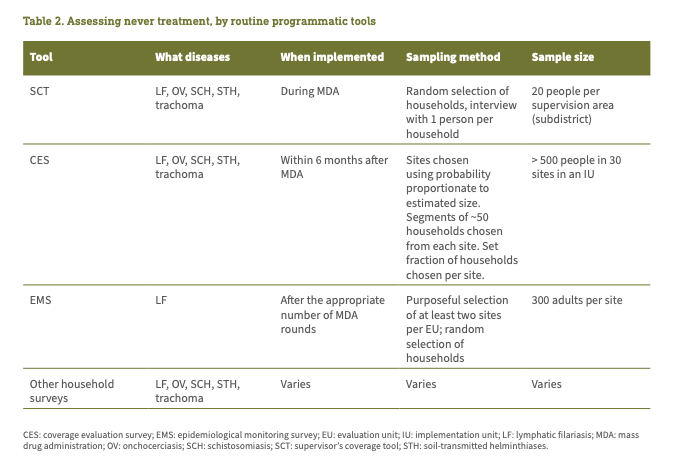
Never treatment only shows up when someone asks about it. The toolkit's core recommendation is to add one question, "Have you ever taken the medicine?", to the surveys programs already run.
- The supervisor's coverage tool (SCT), conducted during the MDA itself
- The coverage evaluation survey (CES), conducted within six months after
- The epidemiological monitoring survey (EMS), used in lymphatic filariasis programs
A benefit is that people answer that question fairly reliably. You might not remember how many times you've had a flu shot, but you remember if you've never had one.
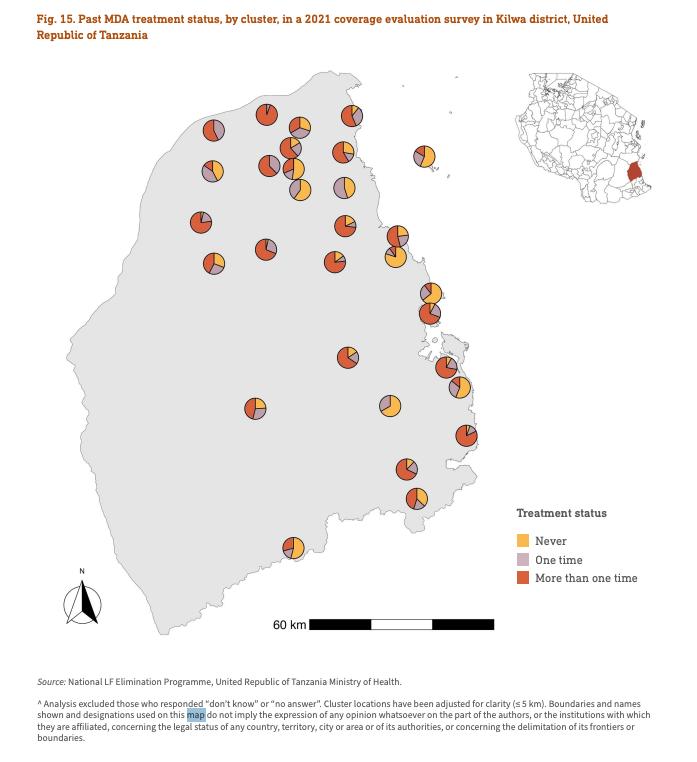
The tension comes after the surveys close. Results arrive as tables by cluster, and a table can tell you never treatment is 20% in one district without telling you which communities drive the number. Tanzania's lymphatic filariasis program solved this in Kilwa district by plotting CES results on a map, and the clusters with high never treatment stand out immediately.
Most programs don't have a GIS team on staff. The ESPEN Geospatial Microplanner, the version of the Crosscut App available in WHO's ESPEN portal, was built for exactly this step. It highlights communities reporting never treated in coverage surveys, alongside settlements missing from community registers and areas that went unsupervised in the last MDA.
What the Never Treated toolkit says to do about it
Geospatial microplanning is named as one of the top interventions. Step one of microplanning is an operational map of every supervisory area showing where never treated groups are located and how large they are. For the mapping details, the toolkit points readers to WHO and PAHO's 2022 microplanning manual, the same guidance we wrote about earlier this year.
The toolkit also warns that microplanning is resource intensive, especially in the first year when teams need to build accurate maps and compile historical data. It suggests prioritizing areas with consistently low coverage, evidence of never treatment, or surveys that keep failing. Building those maps is the part the Crosscut App takes on, generating catchment area maps for every supervisory area from the facility and community lists a program already has.
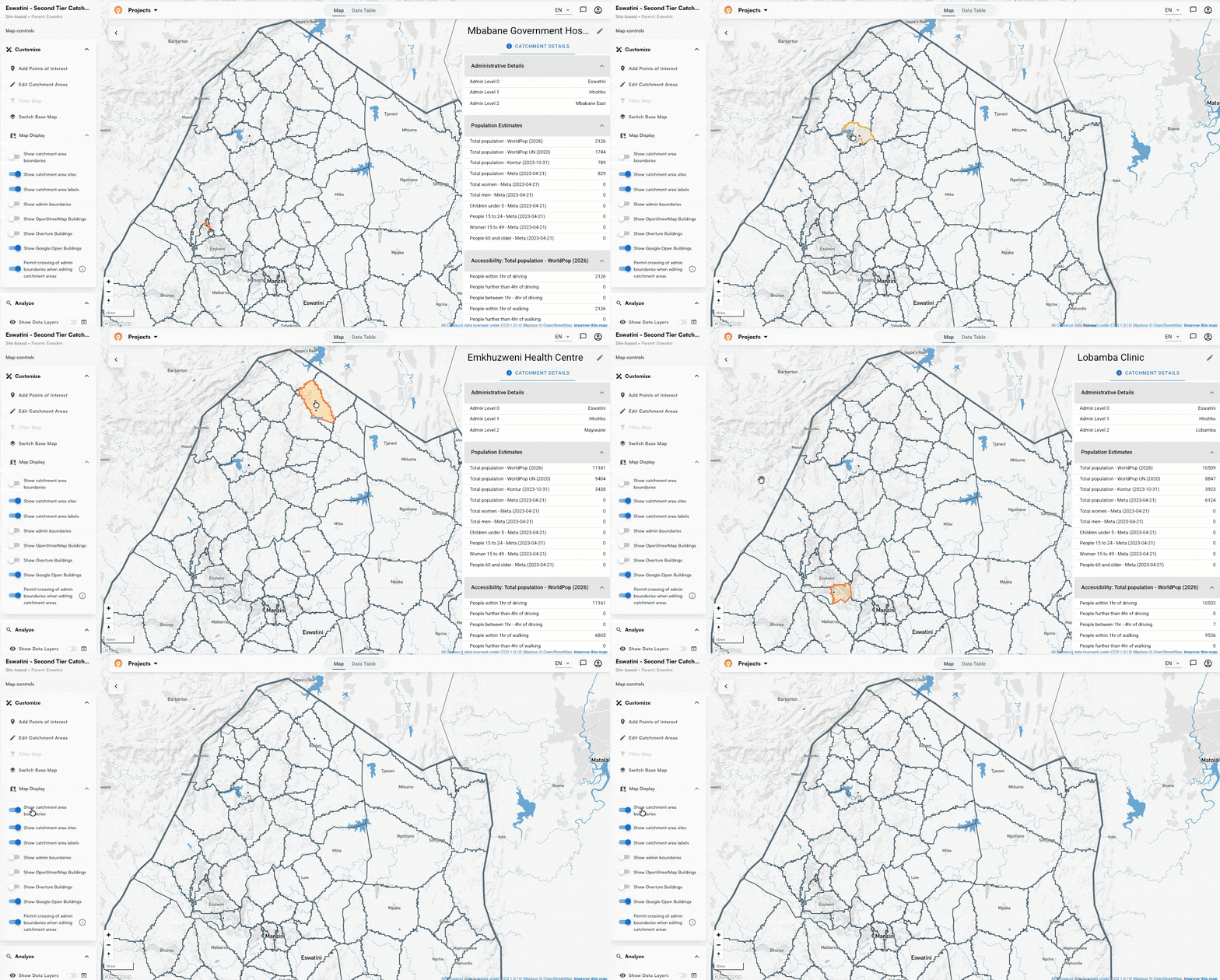
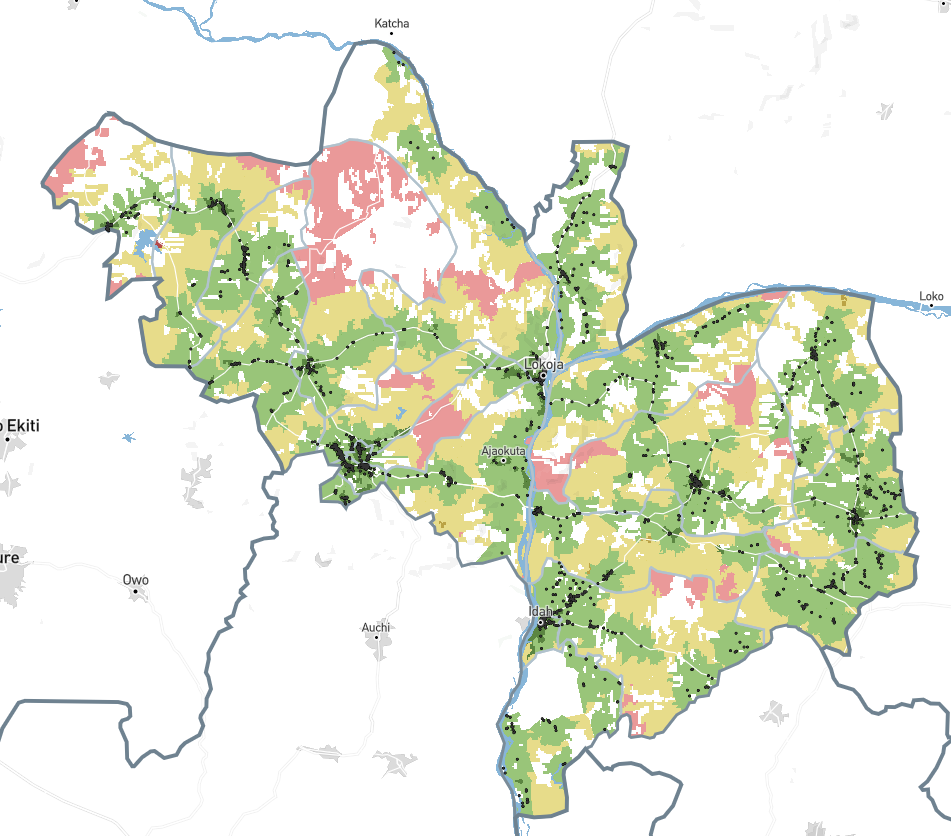
Instead of weeks of costly GIS work, programs can generate catchment area maps for every supervisory area in a few minutes. This is how Kogi State ran supervision gap analysis across an entire NTD campaign. And since microplanning meetings can happen in rooms with few laptops, printable catchment maps carry the same information to the supervisory-area level.
Where the Crosscut App fits into never treated guidance
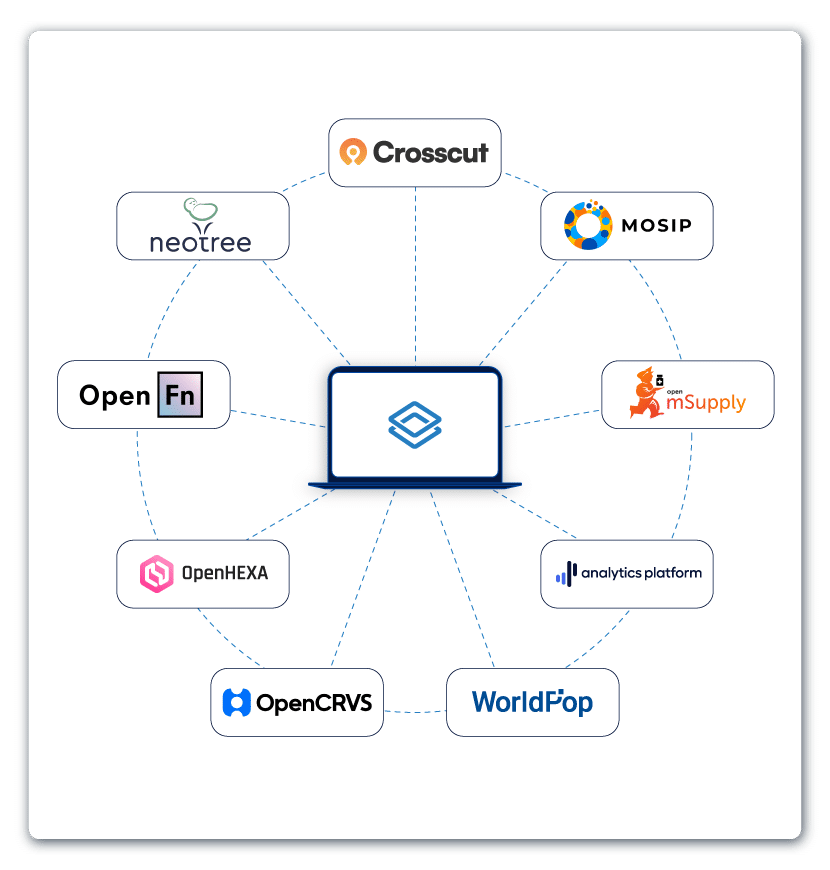
The toolkit strongly suggests connecting never treatment work with other public health campaigns, and programs across Africa are supporting this integration. For years, NTD, malaria, and immunization campaigns have each kept their own community lists and microplans, so the planning work gets repeated and the same communities get overlooked.
Reaching never treated communities is one piece of that bigger goal. In the Crosscut App, the planning happens on an interactive catchment map instead of a spreadsheet and hand-drawn maps, which also makes the work easier to integrate across programs.
Most ministries of health already manage their program data in DHIS2, which makes DHIS2 the natural place for integration to start. As a DHIS2 Strategic Technology Partner, we built the Crosscut App to create catchment area maps inside DHIS2 and publish them back, so a map built for an NTD campaign is available to every program planning in the same system.
Eliminating a disease comes down to coverage
If NTD programs treat enough of the population every round, the parasites will die out. But NTD programs can’t reach that threshold while the same communities go untreated year in and year out. WHO's never treatment guidance shows that finding those communities starts with three steps:
- Add the never treatment question to the next SCT or CES. The toolkit’s annexes include sample questionnaires.
- Map the program’s community list against settlement data to find the places missing from the denominator.
- Build operational maps for each supervisory area before the next MDA, and publish them into DHIS2 if that is where the program plans.
If your program needs to identify never treated communities, the Crosscut App is free to use for building the operational maps WHO’s toolkit calls for. If you're staring at CES results wondering how to turn them into next year's microplan, reach out to us or check out our advisory services.
Frequently asked questions
What does "never treated" mean in NTD programs?
Never treatment describes people who have never ingested the medicines offered during mass drug administration, across more than one round. WHO and PAHO standardized the term in their 2025 toolkit to cover both intentional reasons (refusal, distrust) and unintentional ones (drug stock-outs, distributors never arriving).
How is never treated different from hard to reach?
Hard to reach describes geographic access, often defined as a community several hours from a health facility. Never treated describes a treatment outcome. The two overlap, since remote communities get missed more often, but people in well-served areas can also be never treated for demand reasons like distrust or absence during distribution.
How do health programs measure never treatment?
Programs add a "Have you ever taken the medicine?" question to the surveys they already run. The supervisor's coverage tool carries the question during MDA, coverage evaluation surveys carry it afterward, and epidemiological monitoring surveys carry it in lymphatic filariasis programs. The toolkit provides sample questionnaires for each.
Can an MDA campaign have high coverage and still have never treated communities?
Yes. Reported coverage is calculated against the program's population list, so communities missing from the list don't count in the denominator. A campaign can report strong coverage every year while the same unlisted places go untreated. Finding the communities missing from program lists closes the gap between reported and real coverage.
How does microplanning help reach never treated populations?
The toolkit lists microplanning as its first intervention. Operational maps of each supervisory area show where never treated groups are concentrated so supervisors can plan distribution routes, outreach, and mop-up around them. WHO and PAHO's microplanning manual covers the mapping steps, and printable catchment maps bring them into field planning meetings.
What tools can map never treated communities from survey data?
The Crosscut App builds catchment area maps, estimates populations, and flags hard-to-reach settlements without requiring GIS expertise. The ESPEN Geospatial Microplanner, built on the same technology, adds equity targeting that highlights communities reporting never treated in coverage surveys across WHO's African region.
Related Posts
What GPEI's polio outbreak guidance says about catchment area maps

What WHO's routine immunization guide says about catchment area maps
What the AMP toolkit says about catchment area maps for ITN distribution campaigns
